
Christ in Glory
20” x 20” Cedar, pine, and acrylic paint
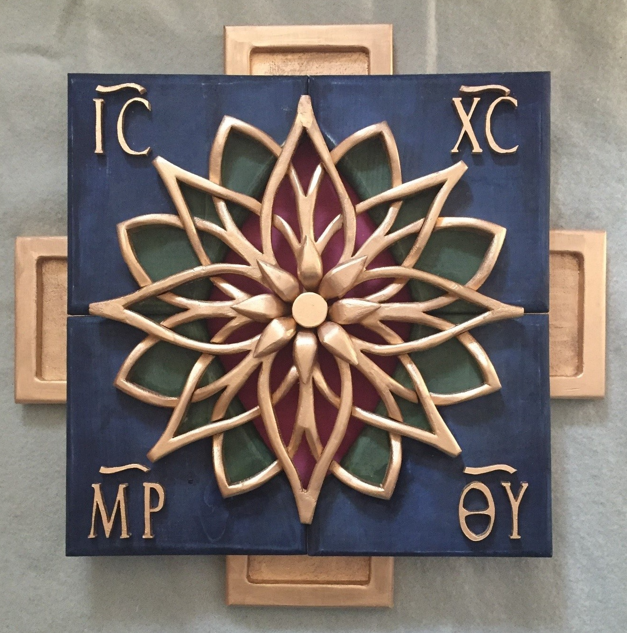
Christian sacred art experienced a major shift in the 4th Century. Prior to this Jesus was portrayed as a common man, a shepherd. Once Constantine proclaimed Christianity as the official religion to the Roman Empire, the image of Jesus sitting on this throne in heaven became a common motif.
While this image is biblical, the reason for this image is obvious. Christ and the Roman Empire are superimposed. The power of Christ, the authority of Christ, were also the power and authority of Rome.
Rome fell, and the motif faded. And yet the image still has resonance. For me this resonance is not tied to temporal, political expressions of faith, but the cosmic Christ, the Christ who made his first appearance, not in Bethlehem, but in the Big Bang. Christ the immanent expression of God.
In my Christ in Glory I chose to replace the image of Jesus with a more universal portrayal of Christ. This is not to minimize Jesus, but to grasp the eternal and universal nature of Christ.
The image of Christ Jesus on his throne was often superimposed on an almond shape. This shape is called a vesica piscus, or mandalora. This shape has several symbolic meanings, but likely in the traditional motif it represented the two-fold nature of Christ – true man and true God. This comes from the fact that the shape is found in the overlap of two circles. One circle: man; second circle: God.
However, the vesica piscus is also a symbol for a woman’s womb. Or more precisely, the vulva, the gateway to the womb. It is through the vulva that the male and female merge to create new life, which is nurtured in the womb and brought forth through the vulva.
I doubt that this symbolism was intended by ancient artists, but the two aspects of the vesica piscus were intended by me.
For me there is a richness in the thought that the Christ, through Jesus, emerged into the world from the womb of Mary. For nine months the blood of Mary flowed through the veins of Jesus, and he was brought forth into the world bathed in her blood. God is revealed to us through a woman’s potency and by means of a woman’s suffering. Note that in my Christ in Glory this vesica piscus is wine colored. In this I draw upon the biblical connection of wine and blood.
Marion theology holds that Mary is the Queen of Heaven and now sits on the Throne of Wisdom. In my Christ in Glory the throne space is a symbol of the potency and wisdom of women. Hence the Greek letters. These are the traditional shorthand for “Jesus the Christ” and “Mary, the Mother of God.”