
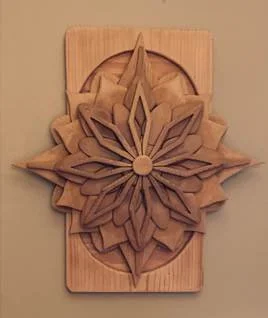
THE CONTEMPLATIVE LIFE
17” x 18” Cedar
Back in the 1970’s the Jesus People movement was in full swing. Small independent churches sprung up everywhere in ad hoc settings – mostly elementary school gyms and cafeterias. We eschewed traditional church buildings. Those were for the dying establishment. We eschewed pastors with M.Div. degrees. Those were establishment custodians. Our pastors were hip young men whose authority came from studying the Bible on their own. They preached in jeans and t-shirts. We felt that we were replicating the early church.
One Sunday in the cafeteria of Ingraham High School in Seattle Pastor Wayne got up to preach. Pastor Wayne had long hair and a beard and looked exactly like the pictures of Jesus in the posters that hung on my walls as a child. He “blew my mind” by noting that the cross was both horizontal and vertical. The horizontal represented Jesus’ relationship with the world, and the vertical represented Jesus’ relationship with his Father in heaven. He stressed that when we wear a cross we are saying that we reach up to heaven and we reach out to our neighbors. Pastor Wayne was one profound dude. That’s what you get when you skip seminary and study the Bible on your own.
Well, maybe. Since that Sunday I have heard that illustration presented in sermons numerous times. Pastor Wayne was not uniquely inspired. But still, that take on the symbolism of the cross has stuck with me, and it was present in the back of my mind when I began to create religious sculptures.
And then, in the middle of creating “The Contemplative Life”, I reacted against this cool insight. I had the vertical axis in place as the background, and as I was attaching the horizontal axis I felt it was all wrong. The piece is a depiction of my own spiritual life. The relationship with God in heaven was okay, but I was going to include the horizontal because…because…well, because a good Christian reaches up to God in heaven and reaches out to his or her neighbor. I realized two things: the first was that I was cramming my spirituality into a medieval dualistic model. God is “up there”, I am “down here”. The second realization was that the horizontal bar also depicted a medieval dualistic understanding – I have a relationship with God; I have a relationship with others.
No. God is not “up there”. God is all in all. God is within, God is without. And my relationship with others should not be separate from my relationship with God. “What ye do for the least of these, you do unto God.”
I dropped the crossbar. I kept the vertical, but not as a symbol of reaching up to heaven, but as a symbol of transcendence. The vertical axis contains a recess, which represents interiority, and from this interiority flows an expansive energy, combining a Christian symbol (the cross), a Muslim geometric pattern (signifying God’s eternal print upon nature), and a Hindu/Buddhist lotus (symbolizing rebirth).
From the depths of my solitude flows a love and solidarity with all of humanity.