
CHRIST IN THE THIRD MILLENIUM
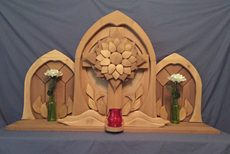
30” x 48” Cedar, glass, flowers, and acrylic paint
When I was in my 50’s I made many trips to Indonesia over the course of seven years serving as a consultant helping several universities develop graduate programs in counselling psychology.
Indonesian universities, as with many universities in “developing” countries, are under pressure to legitimize themselves in the eyes of the universities in “developed” countries. And so with my colleagues in Indonesia we constantly had to deal with how to develop curriculum and programs that balanced “looking good to America” and meeting the actual needs of the people of Indonesia.
I remember a meeting in which we went over the course requirements for counsellor certification in North America. My colleagues were wearily asking, “Why do we need to teach this class? Why do we have to cover that material?” And then, “Where in the curriculum is there room for us to integrate Panca Waskita?”, which is the “seven wisdoms” of traditional Javanese thought.
One evening, after a day of working on curriculum, my colleagues and I were having dinner on restaurant patio. I looked up at the stars and suddenly became disoriented when I saw the constellation Orion. It was upside down! It was in the Northern sky! I’ve never been much of an astronomer, but at least I prided myself on being able to locate the North Star, and therefore The Big Dipper, and then turn around and find Orion in the Southern sky. For thousands of years my culture has been doing this, using these as anchors in navigation. But there in Indonesia Orion was in the North, not the South, and there was no North Star. Their stellar point of reference was the Southern Cross constellation.
This hit me as particularly salient in my consultation work. My Indonesian colleagues were highly intelligent, but struggled with why American psychology was hung up and some principles they felt to be irrelevant.
The philosopher/theologian Raimon Pannikar has pointed out that Christians have tended to go to non-Christian countries and have criticized the cultures and religions for having “the wrong answers”, when in truth, they have seen the world through a different lens and have given insightful answers to the questions their cultures asks. It reminds me of an old joke: “Drinking is not the answer! The answer is Bismarck. The question is ‘what is the capital of North Dakota?’”
So what does this have to do with this piece “The Church in the Third Millenium”? To begin with, the piece is misnamed. This was the name I originally gave it, but the piece and the name bothered me for several years and I didn’t know why. I actually tucked the piece away in my closet for several years because it bothered me. And then I began to understand it. I should rename it “A Tribute to Bart’s Thick-headed Eurocentrism”, but I’ll offer myself a little kindness. The piece actually rose out of an attempt to address another area of my short-sightedness, in which I couldn’t see beyond the United States in the 20th Century. I grew up with the vague impression that Christianity began in the 1500’s. Of course, there was the time of Jesus and the Apostles, but then there was a brief, hazy time of hocus-pocus Catholicism. This was a time where priests wore wizard-like robes, bowed to sacred pictures and waved incense around. But that quickly faded into the “real” Christianity of Protestantism. But mainstream Protestantism – Lutherans, Methodists, Baptists, and Presbyterians- was just laying the foundation for the “authentic” Christianity of the Evangelical and Charismatic movements, which, of course, was all about a return to first century Christianity.
In this piece I wanted to acknowledge that my faith had its roots in 2000 years of history, and what was going on in the church in the 800’s and 1100’s and the 1300’s no doubt impacted how I view God and relate to God as much as what was happening in the Jesus Movement in the 1970’s.
“The Church in the Third Millennium” is a triptych, a three-panelled piece, and each panel represents a millennium – the years 0 – 1000, the years 1001 – 2000, and now the years 2001+. I first thought to find a representative saint for each millennium and plant them into the right and left panels (which are stylized church windows), but I realized it would be impossible to find any one person for each millennium, so I used white roses, which are a symbol for sainthood. So the roses represent all the saints that went before us.
I have come to realize that there are, in fact, apt persons for each millennium, but they aren’t saints. In fact, they weren’t even Christians. In the first millennium Plato was arguably the most influential figure in shaping the Christian faith, and in the second millennium the most influential person was arguably Aristotle. I would like to flatter myself in thinking that I am a pure, Bible times Christian, but really my spirituality is shot through with neo-Platonic themes and my religion is shot through with Aristotelian constructs. I seek to someday leave this mortal world and join God in heaven. What does that look like? Just ask Plato and Plotinus. And my faith rests on clear critically examined constructs and a historical faith. How does that get formulated? Just ask Aristotle and the Scholastics. My way of “faithing” is grounded in Eurocentric constructs.
So what of the 21st Century? The tidy world of scientific certainty began to collapse in the 1900’s. Quantum physics has thrown Platonic cosmology and Aristotelian certainties out the window. There is no heaven “up there”, because the universe is non-dualistic, and the world is not made up of matter, but all is energy. This doesn’t mean that Christianity isn’t true, it just means that going into this third millennium, Plato and Aristotle are not helpful in understand God.
In the centre of “The Church in the Third Millenium” I put a cross integrated with symbols of other world religions. I’m not sure why. It was probably a reflection of my own journey, but now I see that it fits. As 2000 years of Western thought is getting overhauled we are more and more becoming a global community and knowledge between cultures is becoming shared. I’m not advocating mixing all the religions together and coming up with a one-world religion. Those involved in intrareligous dialog encourage us all to learn from each other, but only after one is grounded in their own religion. Pannikar shares the metaphor that we are all residents of a global house. Some of us are looking out the window to the North, some out of the South, East and West windows. They all have a different view of what the world out there is all about. Our view is our own, but we don’t really get a full picture unless we hear those who are responding to different viewpoints. Plato has served me well, but listening to the words of Jesus through the lens of Tao gives me a fresh depth of understanding and love for Jesus. Aristotle has served me well, but the symbolism of The Dance of Shiva helps me integrate quantum physics into my awe of God’s grandeur.
That seems like a good place to stop, but I can’t end without noting two other symbols in the piece. There is a candle in a red holder. In the Catholic Church this symbolizes the presence of Christ. There is water flowing from the bottom of the piece. This symbolizes the Holy Spirit. The image is drawn from The Old Testament (Ezekiel 47) and from The New Testament (Revelation 22).