
THEORIA PHYSIKA
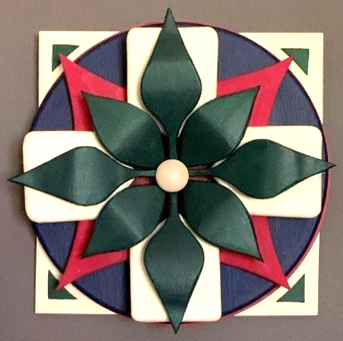
11.5” x 11.5” Pine and acrylic paint
“The whole cosmos is incarnational. Christ is organically immersed
with all creation, in the heart of matter, thus unifying the world.”
Ilia Delio, “The Hours of the Universe”, pg. 64
When I was in academics I taught a graduate course on Crisis Counselling. Entering the class, my students usually assumed this meant following up on the issues people call into crisis lines about – the “my life is falling apart, I want to kill myself” issues. There is that, but the topic is much broader. The word crisis has come to mean a traumatic event, but the Greek root means “to choose”, with the implication that a situation has changed and one must make conscious decisions about life going forward. A wedding is a joyous crisis. Retirement is a crisis. Divorce is a crisis. A job offer is a crisis. The death of a loved one is a crisis. Life has changed. How do we adapt to this change?
When people decide to go to therapy, it is often because they are faced with a crisis. And often the issue is that they don’t want to face change, but their current situation has become untenable. Clients share their distress with me, and what I often hear is some variation of, “Make the change go away. Help me make life go back to what it used to be.” Change is considered an enemy to be conquered.
In the course I would give my students the assignment of spending 10 – 15 minutes in nature and ask nature to teach them something. (I sometimes give this assignment to my clients.) They are not allowed to force any topic. They must be receptive to the lesson nature chooses. This may sound weird and New Agey to some, but my students usually reported that to their amazement nature “spoke” to them and usually with an unexpected message. This message was usually along the lines that change is inevitable and that death is a constant reality. Everything is constantly changing, and yet everything remains the same. And death is all around us. There are dead branches everywhere, there are dead leaves, dirt is made of dead organic material. And yet from this abundance of death springs an abundance of new life, of new growth. (This may sound a little morbid, but when you walk through a supermarket almost everything on all sides of you is something dead. And yet, ironically, that’s where we go to sustain our lives. But nature would say, “Irony? What irony?”)
However, I want to go beyond the notion that nature just supplies us with object lessons. There is an energy in nature that communicates with our natures. I am amused, and a little saddened, when I hear someone trying to discount Christianity by saying, “How can you believe that there is this all-powerful person in the sky concerned about the daily affairs of six billion people? My spirituality is being out in nature and taking in the wonder of it all.” The irony of this is that in saying this, they are siding with the views of the early church fathers. If you believe (as many of us were led to believe), that the earth is down here and heaven is up there, and that’s where God is – well, be thankful you weren’t living in the days of the early church. You might find yourself rotting in a Constantinople dungeon on charges of heresy.
Science and Greek cosmology has done us a great disservice by promoting this dualism between the natural world and the spiritual world (or even denying a spiritual world). But science is doing us a favor with their current emphasis that everything is energy, or even that everything is consciousness. Jesus said, “God is spirit.” In 21st Century language we might say, “God is energy; God is consciousness.” And everything is energy, and everything is consciousness. But not everything is God. That is pantheism. The early church believed that the spirit of God is present in everything, pervades everything, and yet at the same time God transcends everything. This is panentheism.
The early church believed in getting in touch with God by contemplating nature. They called this “theoria physike”. In modern language this would be to say that you are contemplating a tree, not because you might draw some analogies from it, but because your energy is connecting with its energy and the energy that flows between you is the primary energy of the universe. You don’t have to call that primary energy “God”, if that bothers you, but I call it God.
This piece, “Theoria Physike” is a juxtaposition of a nature image (a plant), a universe image (four corners), and an Christic image (the cross). They are separate but they are one.