
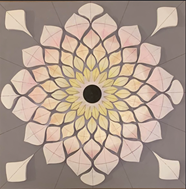
SPIRITUAL TRANSCENDENCE
18” x 18” MDF Board and acrylic paint
I was between projects. I decided to take a break and do something easy. I had a drawing hanging up on my bulletin board that I thought I could use to knock off a piece in one week. It was a sketch based on the interior of the dome of the Mosque in Isfahan, Iran,
The picture had been haunting me for months. My eyes were constantly drawn to it, and I felt I would feel no peace until I rendered it in wood.
What I thought would be a simple knock-off became a strenuous dialog between the design and me. I would do some work and then realize that if I continued that vein, it would “be wrong”. I would produce something that disturbed me and I would end up throwing it away. This pattern continued for 4 weeks. I would make a logical decision about design, and it was as if the emerging piece would block me with the message, “This piece is expressing your soul, not your logic. Quit thinking.”
To begin with, my least favorite colours are yellow, pink and orange. I kept trying to avoid these, but the piece said, “I am a sunrise. Use the colours you need to produce a sunrise.”
And then I struggled with the background. My favorite colours are green and blue, but the piece blocked me on these. The colour that the piece and my soul agreed upon was puce. Puce? Yuck. Yes, puce. (puce is purplish-brownish-gray) The piece said, “Not only am I a sunrise, I am a lotus.” The lotus is a Buddhist symbol of spiritual purity and transcendence. A pure white flower floating on a still pond (a symbol of the conscious/subconscious/unconscious self) with its roots in the mud of the pond bottom (the mundane world).
As I was completing the piece I began to make discoveries. I assumed that I was recreating an Islamic motif. But gradually I began to also discern Christian mysticism, Hindu spirituality. There were seven layers of the design, reflecting the seven chakras which progress upward progression of energy into transcendence. Moreover, each layer had 16 petals. In my work I love the symbolism of 4’s and 3’s and 12’s. But 16? What was I doing? It turns out that 16 is a symbol of the throat chakra, which is a one-step progression from the heart chakra. The throat chakra is about self-expression – expressing from the depths of the love one has gotten in touch with through the heart chakra. I was reminded of the progression experienced by the Sufi theologian/poet, Rumi. He was in the world as the most respected Muslim philosopher of his day. He then had a spiritual awakening and spent several years withdrawn from society (getting in touch with his heart chakra?). He then moved into producing thousands of mystical love poems (expressing his throat chakra?)
But there is another symbolism in the number 16. As I said, I love working with the symbolism of the number 4. It represents completeness in the physical world, which can be seen in north/south/east/west, or mother/father/son/daughter, or spring/summer/fall/winter. The number 16 is a factor of 4 x 4, therefore “a completeness of completeness”, or the meta-reality of nature, the underpinning essence of the natural world. Nature and the transcendent are not dualities but are one. And so the process of transcendence is not the shedding of the body and the world, but a full integration of God, the person, and nature.
I believe my piece was trying to give me a message.
But if this piece is an expression of my soul, what about the fact that my core spirituality is Christian? I began to realize that my Christianity was subtly imbedded in the piece. It’s not a circle, it’s a cross. Not a typical Christian symbol cross, but one that emphasizes the quaternity aspect of the symbol, namely that there is a vertical energy (…thou shalt love the Lord your God…) and a horizontal energy (…thou shalt love your neighbor as yourself…). In addition, a double vesica piscus can be detected. A vesica piscus is the almond shape that occurs when two circles overlap, and traditionally the circles represent the two natures of Christ: divinity and humanity come together in the person of Jesus.
But the vesica piscus has another symbolic meaning, and that is the energy of the feminine. The vesica piscus is a representation of the womb or the vulva, the centre of feminine power and mystique. These two symbolic representations are usually seen as separate, but to me I see the womb of the Virgin Mary, in which she nurtured divinity/humanity. This feminine energy is not only alluded to in the Mariology spirituality of Christianity but is emphasized in the Jewish Kabal concept of “shekinah”, the Sufi reverence of feminine wisdom, and of course the “yin and yang” of eastern spiritualities.
In the piece there is also a series of three rings, emanating from a black centre. The black centre represents “ego death”, the relinquishing of self-identity to God, or “the higher power”, beginning the path of transformation to transcendence. The three rings, then can represent the three stages or states of spiritual growth towards transcendence: the purgative state, the illuminative state, and the unitive state. The purgative state is the state of spirituality where one realizes that a relationship with God is “right for them”, and they seek God to become a more genuine person. The illuminative state is where the person loves God whether God bestows blessings or not – loving God for being God and not for what one can get out of the relationship. The unitive state is where God no longer becomes an object. One does not love God – God is love and they are in God, so they are love. God is within and the boundaries between God and the person disappear.
And this leads me back to Hinduism, where you have a similar progression, where you have three “conditions” of a person’s existence. Understanding these and exploring these provide the framework for attaining transcendence. These are the “gross body”, the “subtle body”, and the “causal body”
As I was understanding what was emerging from my piece, two quotes came to mind. The first is from Vatican II:
“Likewise, other religions found everywhere try to counter the restlessness of the human heart, each in its own manner, by proposing "ways," comprising teachings, rules of life, and sacred rites. The Catholic Church rejects nothing that is true and holy in these religions. She regards with sincere reverence those ways of conduct and of life, those precepts and teachings which, though differing in many aspects from the ones she holds and sets forth, nonetheless often reflect a ray of that Truth which enlightens all men.”
- “Declaration on the Relationship of the Church to Non-Christian Religions”, Nostra Aetate, Proclaimed by His Holiness, Pope Paul VI
The second is from the Sufi theologian/philosopher Ibn al-Arabi:
“There was a time when I took it amiss in my companion if his religion was not near to mine;
But now my heart takes on every form;
It is a pasture for gazelles, a monastery for monks,
A temple for the tables of the Torah,
A Ka’bah for pilgrims and the holy book of the Quran.
Love is my religion, and whichever way its riding beasts turn,
That way lies my religion and belief.”