
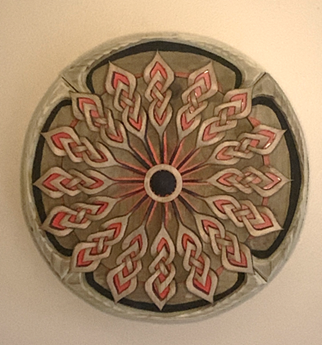
TRUTH AND RECONCILIATION
14” x 14” Cedar and acrylic paint
There are some weeds along the side of the street about a block from my house. They look like white mist and don’t stand out much from the sidewalk and chain link fence, but if you look closely, each plant is a cluster of little white flowers with exquisite geometric patterning.
Once a year the city sends a crew to hack them back in a futile attempt to eradicate them. This piece, “Truth and Reconciliation: Every Child Matters”, has its design inspired by these weeds.
In my country, Canada, there are Indigenous People. Because they had no written records of their history, the white settlers did not consider them to be civilized. Because they did not own property the white settlers did not classify them as having the rights of citizenship. (One must be a white male property owner in order to vote, back in the day.) The settlers claimed their land because they were considered wildlife. One wouldn’t think twice about moving onto land occupied by deer and squirrels, after all.
The government sought to “enlighten” the Native People beginning in 1857 with the “Gradual Civilization Act” which offered opportunities to the Natives, and in 1876 with the “Indian Act” which made assimilation mandatory. It set the tone for outlawing Native cultures. Rituals were banned; children were taken from their families and placed in residential (boarding) schools where their language and culture was forbidden. Native culture was basically a weed that needed to be hacked away. The government enlisted churches to run the residential schools – the Catholic Church, the Anglican Church, the United Church of Canada, and the Presbyterian Church. It was felt that forced conversion to the Christian faith was an essential aspect of becoming a “civilized” Canadian.
Culture and language was largely eradicated, but not totally. Many Native People became Christians. And the trauma of being separated from family and community has created persistent generational mental health issues, including child abuse and substance abuse, and a high suicide rate. This is a result not only of separation, but of the atrocities that the children suffered while in these schools, which included physical, emotional and sexual abuse, and unethical human experimentation. Also, the mortality rate was quite high. Lots of these little kids died in these schools.
In 2008 The Truth and Reconciliation Commission was established by the Canadian government in order to examine and address the legacy of residential schools. They submitted their recommendations in 2015. The work of presenting the truth and making reconciliatory policies is ongoing. As a part of telling the truth, telling the stories of abuse September 30 each year is a day dedicated to “Orange Shirt Day”, in which Canada remembers the victims of residential schools. (There is a story about a Native child who was given an orange shirt by her mother to remember her by when she was taken to a residential school. The school confiscated the shirt.)
In the fall of 2021 thousands of unmarked graves containing Native children were beginning to be discovered on residential school lands. This piece, “Truth and Reconciliation: Every Child Matters” was completed on September 30, 2021, as my personal memorial. It integrates West Coast Canadian Native motifs – formline drawing, bare cedar, and traditional colors. However, I did not want to appropriate Native art as my own creation, so I incorporated European knotwork (Celtic and Nordic). After all, my ancestors appropriated Native land. For me to appropriate Native art would just continue the trend. But more than that, I wanted to integrate my Eurocentric background with the Native motifs to symbolize that I am implicated in the attempted genocide of Indigenous people of North America. My Native colleagues have stressed to me that “settler guilt” is not appropriate, nor helpful. I was not the one who stole the land. However, I am a benefactor of the oppression of Native people. It is a place to start. Being guilty and being implicated are two different things. I also integrated the knotwork because I wanted to indicate my solidarity with the Truth and Reconciliation process.
I have had my own battles with “weeds”. I have tried to have a nice lawn and a lush garden on my mid-sized suburban lot, but I live in the Vancouver area, in which plants grow in profusion. Native species and “invasive” species constantly overtake the species I have decided on. I used to try to grow interesting plants and vegetables that were not amenable to my climate. They didn’t seem to be happy that they are in British Columbia, and I fought off the plants that want to thrive. It finally occurred to me that many of the plants that grow naturally and thrive on my lot are beautiful, and some are beneficial, both nutritionally and medicinally. I have let my lot go mostly natural and have actually integrated some “weeds” into my vegetable beds. I no longer fight dandelions; I enjoy their beauty and then I eat them. And it’s interesting, the plants that want to grow on my lot tend to be beautiful and nutritious. There’s clover, wood sorrel, mullein, mint, lemon balm, blackberries, and ivy. The ferns aren’t edible, but they sure are beautiful. And nature has decided to give me a maple tree, an oak, and several hazelnut trees, all planted in perfect locations. And so I have a running dialog with nature; a constant negotiation. The “volunteer” plants may grow in my yard, but they must live in harmony with my beets, beans, kale, asparagus, and spinach. There is much peace in my yard.
Maybe this is a nice analogy of the reconciliation that can happen between Indigenous Canadians and the dominant culture, but I feel it is more than that. The Eurocentric values of control and domination have proved to be damaging our ecology and oppressing the people who have much to teach our society about living with God and nature. Jesus taught that if you want to know God better, get in touch with nature and learn from her. His teaching was full of lessons from nature. If we try to control nature, which is futile, and thoughtlessly whack down weeds everyone suffers.