
Inanna’s Ordeal
17” x 17” Pine and acrylic paint
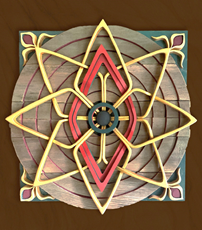
[note: in other traditions, Inanna is known as Ishtar]
The Mesopotamian goddess Inanna descended into hell. There had been a relationship rupture between her and her sister, who was the queen of hell, and she sought to repair the damage. As she descended, she was stopped at each of the seven gates of hell. At each gate she was told by the guards to give up one item. Initially it was her items of defense - spear, sword, breastplate, and helmet. At each demand from the guards, she asked why she must do this. They responded that no explanation would be given to her. At the final gates she was ordered to give up articles of her clothing - the royal raiment that gave her identity. So, at the pit of hell she had been stripped of all her defenses and identity, and she stood naked. She had lost her defenses, and she had lost her identity, and then she was slain and lost her life.
[I find it interesting that St. Teresa of Avila, talks about the seven stages of prayer, in which each stage releases a degree of ego, resulting in a totally “naked” ego resulting in a transcendent unity experience of God. Likewise, Ibn al-Arabi talks about seven stages of the soul’s development, again, with each stage releasing a degree of ego, resulting in a transcendent unity experience with Allah.]
She was told that she could regain her life and return to the upper world, but it would cost her a valuable relationship, either her husband or her best friend, who would die in her stead.
She chose to give up her husband, and she returned to the upper world transformed. Through her husband experiencing cycles of death and rebirth, she received back her husband but in a far different relationship, a relationship whose cycles transformed the world.
In this piece I have an eight-pointed star, which is a symbol of Inanna; a vesica piscus, which is a symbol of the essential energy of women; the seven layers of hell; the black centre, symbolizing ego death; and the four corners of nature, symbolizing Inanna’s association with the cycle of the seasons.