VISIO DIVINA
VISIO DIVINA MEDITATION
Meditation with art, visio divina, takes two forms: the artist meditates in creating a piece. The act of creating is prayer. The second form is the observer, contemplating the symbols, colours, forms, and the subject matter. The observer will likely have a totally different understanding and spiritual experience of a piece than the artist. I have written about my own meditation/theologizing in producing each piece, but I do not offer that here. These writings are available on the website:
You may meditate by closing your eyes, quieting your thoughts and being aware of your being. This is contemplation. You can meditate by reading a passage of scripture or a few brief sentences in a book with a spiritual focus and letting those words go deeply into your soul. This is lectio divina. And then, you can meditate by gazing relaxedly, but intently at a piece of artwork, letting the forms and symbolism speak to a deeper part of yourself. This is visio divina.
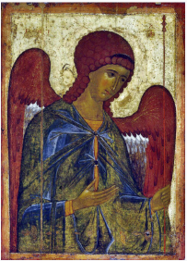
The practice of visio divina has traditionally been used with icons. Icons are not realistic paintings. They are stylized and full of symbolism in order to disengage the rational parts of the brain and engage the intuitive and subjective parts of the brain. The person producing an icon is not an artist, in the modern sense of the term, but someone engaged in prayer who is reflecting that prayer into art media.
Gabriel from Vygotsky chin (14c, Tretyakov gallery)
Wikimedia Commons.
In recent years, the practice of visio divina has expanded to forms beyond icons. My website has many examples of this. Each piece represents many hours, usually two to four months’ worth of my own meditations interacting with forms, concepts and symbols, and with the medium of wood and paint. Hopefully, you won’t see these as interesting or pretty pictures, but that in them you can find your own prayer and meditation.
How to Practice Visio Divina
The process involves several steps:
Prepare yourself by making yourself comfortable, placing all cares aside for now, and taking three deep breaths. Inhale through your nose; exhale through your mouth.
You may say a brief prayer or mantra. It is important that if you say a prayer, it not be spontaneous and conversational. Such a prayer will engage the rational areas of the brain, which is what you want to avoid. Rather it should be a written prayer. I like the Anglican Collect for Purity:
“Almighty God, to you all hearts are open, all desires known, and from you no secrets are hidden; cleanse the thoughts of my heart by the inspiration of your Holy Spirit, that I may perfectly love you, and worthily magnify your holy Name; through Christ my Lord. Amen.”
Open your eyes and quietly observe the image. Notice the patterns and colours. Don’t force any interpretations but let the image take you where it wants. If one aspect of the image seems to grab you, stay with it.
Notice any thoughts, emotions or memories. Is there a spiritual principle, a story, or a remembered dream that impresses itself upon you?
If you are religious, pray. Speak with God about your experience and/or insights.
Rest. Close your eyes, breathe deeply and sit in silence. You will know when you are done.
A GUIDE TO SYMBOLLISM
The visio divina becomes more powerful when symbolism is understood.
Numbers
3 God, divinity. Not only because of the Christian Trinity, but because most religions have a triad understanding of divinity: 1. The transcendent, unknowable, creator, 2. The physical, this-world manifestation of God, and 3. The energy of spirit of God in the world.
4 Nature, this-world. Because of four seasons, four directions, four primary relationships (mother, father, daughter, son), four limbs (two arms, two legs), four fingers, four toes/four thumbs-big toes.
5 The human body. Two arms, two legs spread, with a head, creates a 5-pointed star.
6 Various. The natural world (north, east, south, west, up, down); humans (created on the sixth day.)
7 Completion (seven days of creation), God + Nature = the transcendent becoming immanent.
Note multiples as a springboard for interpretation, e.g., 12 = 3 x 4, 16 = 4 x 4
The Cross
Aside from the obvious representation of Jesus’ suffering and death, it is also a Jungian symbol for completeness – a resolution of opposites on two planes. It also sets up the symbolism of four. As well, it can represent the vertical relationship (earth and heaven, immanence and transcendence) intersecting with horizontal relationships (social).
Vesica Piscis
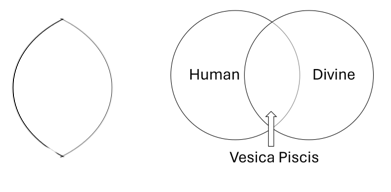
The vesica piscis not only can represent the essence of woman, in that it is a representation of the womb or vulva, but it is also a symbol of the dual nature of Christ: human and divine.
Flowers
Rose Various, depending on color. A white rose is a symbol of holiness, a red rose is a symbol of true love, etc.
Lotus Transcendence, spiritual growth, noting that this beauty rises from the depths and mud
General florals The earth as the garden of God, growth, abundance
Islamic Geometry
All Islamic geometry is meant to reflect God. The patterns are usually able to replicate infinitely; therefore, the geometrical patterns attest to the beauty, order, and infinity of God
Colours
Gold Purity and regality
Green The earthly realm, nature
Red Passion, growth, lifeblood
Blue Eternity
Black The absence of Self – ego transcendence. The all-seeing eye, or the unknown
Circle
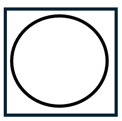
The circle symbolizes completeness, wholeness, or infinity. A combination of these elements equals transcendence.
For a circle to be in a square adds significance. A square is four sided, or the corners represent four directions. With four being a symbol of the natural world, then a circle in a square represents eternity or transcendence imbedded in the natural world